Generic AI Isn't Cutting It for Event Outreach. Here's What Actually Works.
Sales teams at trade shows and events are drowning in repetitive outreach tasks — yet generic AI makes it worse. Learn how event-specific AI with deep company context unlocks real results.
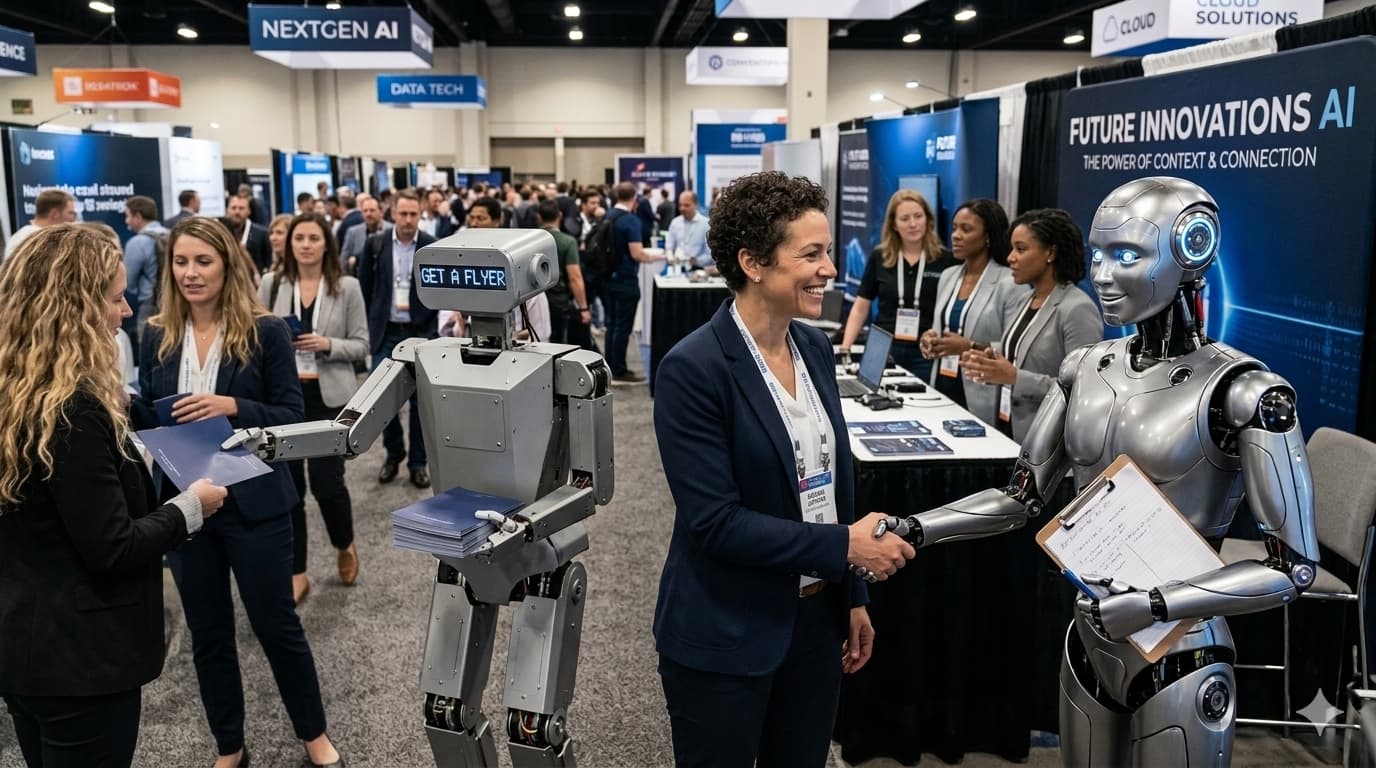
You're exhibiting at a major trade show. You have a list of attendees. You have AI. And yet your outreach looks like everyone else's — vague, forgettable, and almost certainly ignored.
The problem isn't your offer. It's that the AI you're using knows nothing about the companies on your list.
Generic AI tools can generate emails fast. What they can't do is tell you that the VP of Operations you're targeting just went through a company restructuring, that her firm expanded into a new vertical last quarter, or that the pain point she came to this show to solve is exactly the one your product addresses. Without that context, your message is noise. And at an event where every exhibitor is blasting the same AI-generated templates, noise is all most outreach ever becomes.
The Gap Between AI's Promise and Event Sales Reality
AI was supposed to give sales teams leverage. In many contexts, it has. But the event sales environment has a specific problem that general-purpose AI tools are fundamentally not built to solve.
Event outreach is time-compressed and context-dependent. You have a narrow window — days or weeks before the show — to reach the right people, with the right message, before their calendars fill up. That window demands outreach that is specific enough to earn a reply, at a volume large enough to actually move the needle.
Generic AI can handle volume. It cannot handle specificity. And specificity is exactly what separates a booked meeting from a deleted email.
This isn't a theoretical problem. According to HubSpot's 2024 Sales Strategy Report, 45% of sales professionals are overwhelmed by their tech stack — and AI tools designed for general use are a major contributor. Meanwhile, 81% of reps believe AI should help them spend less time on manual tasks. The gap between expectation and reality is widest in high-context environments like events, where generic outputs require the most human correction before they're usable. The AI tools they're using don't know the event, don't know the attendees, and don't know why someone would walk the floor at this particular show looking for a solution like yours.
Why Deep Company Context Is the Variable That Actually Moves Replies
Think about the last cold email that made you stop scrolling. Odds are, it referenced something real about your situation — a company milestone, a shift in your market, a challenge that was clearly visible if someone had bothered to look.
That's what deep company context does. It turns a generic pitch into a message that reads like it was written for one person, because it was informed by what's actually true about that person's business.
For event outreach specifically, context operates on two levels:
1. The event context. Why is this company at this show? What vertical does the event serve? What are the typical buying triggers for attendees in this space? A message that acknowledges why someone is at this event, not just any event, immediately reads differently than a standard template.
2. The account context. What's happening at this company right now? Have they launched a new product? Entered a new market? Hired a new head of operations? These signals tell you not just who to reach, but what to say — and they make your outreach feel like research rather than spam.
Without both layers, your outreach is guessing. With them, it's qualified.
How to Build Event Outreach That Actually Converts: A Step-by-Step Breakdown
Step 1: Start With the Attendee List — Then Go Deeper
Most exhibitors treat the attendee list as the finish line of prospecting. It's actually the starting point.
Once you have a list of registered attendees or target companies for an event, the next step is enriching each account with live company intelligence: recent funding rounds, executive changes, product launches, hiring patterns, press mentions. This enrichment is what separates a name on a spreadsheet from a qualified, contextual prospect.
Manual enrichment at scale is impossible in a pre-show window. Automated enrichment — pulled from company databases, news feeds, and firmographic sources — makes it tractable.
Step 2: Segment by Signal, Not Just by Firmographics
The default segmentation for event outreach is: company size, industry, job title. These are table stakes. The exhibitors who book the most meetings go one level deeper.
Segment your attendee list by behavioral and situational signals:
- Companies that recently raised capital (budget available, growth mode)
- Companies that hired into a function your product serves (active pain point)
- Companies that expanded into a market where your product applies
- Companies whose contract with a known competitor is likely expiring (detectable via job postings referencing vendor evaluation, G2/Capterra reviews mentioning switching intent, or LinkedIn posts about re-evaluating tools)
Each segment gets different messaging — because each segment has a different reason to talk to you at this specific show.
Step 3: Write Outreach That References the Event and the Account — Not Just One
This is where most AI-assisted outreach breaks down. Tools that generate event outreach reference the event. Tools that generate personalized outreach reference the company. The message that books meetings references both, in a way that makes the connection feel inevitable.
Example of what this sounds like in practice:
"Saw you're attending [Show Name] next month — given that [Company] just launched into [new vertical], I'd imagine the [specific topic] sessions are on your radar. We help companies in exactly that position move faster on [specific outcome]. Worth 20 minutes while we're both there?"
This isn't a template. It's a structure. The variables are only fillable if you have the context — the event angle and the account intelligence — in the same place.
Step 4: Time the Sequence Around the Show, Not Around Generic Drip Logic
A standard email sequence sends messages on Day 1, Day 4, Day 7, Day 14. That logic has nothing to do with events.
Event outreach sequences should be timed around the event calendar:
- 4–6 weeks out: Initial outreach to high-priority targets. Enough lead time to get on the calendar.
- 2 weeks out: Follow-up with urgency framing — meeting slots are filling, agenda is set.
- Week of: Short, direct message to confirm or pivot to a floor meeting.
- Post-show: Immediate follow-up while context is fresh, before the pile of business cards gets lost.
Each touchpoint has a different job. A generic drip sequence doesn't know any of that.
Step 5: Protect Your Strategic Time for the Floor
All of the above — enrichment, segmentation, personalized messaging, sequencing — should happen before your team boards the plane.
The point of event-specific automation isn't to generate more outreach. It's to handle the research and personalization overhead so your team's energy is protected for what only humans can do: the in-person conversations, the relationship building, the reading of the room that turns a quick intro at a booth into a serious pipeline opportunity.
When outreach runs on autopilot, your reps walk the floor with warm prospects — not cold lists.
The Bottom Line: Context Is the Competitive Edge
Everyone at your next show has access to the same generic AI tools. That's precisely why generic AI won't differentiate you.
The exhibitors who book the most meetings before the doors open are the ones whose outreach demonstrates that they did the work — that they know who they're talking to, why that person is at this show, and what's happening at that company right now that makes the conversation worth having.
That level of specificity used to require hours of manual research per account. Event-specific AI with deep company context makes it scalable.
At Outrizz, we build exactly that: automated pre-event outreach that combines event intelligence with real-time account data, so every message your team sends reads like it was written for one person — because the context behind it was. If you're exhibiting at a trade show and want to walk in with a full meeting calendar, that's what we do.
Share this article
About the author
Ready to book meetings at your next trade show?
We guarantee 10 qualified meetings before you arrive — or your money back.
Check event fit